Most companies think they're being smart with their budget by putting off mobile security testing. "We'll deal with that later," they say. "Let's just get the app out there first." But here's the brutal truth that's going to hurt your wallet: fixing security problems after your app is live costs way more than catching them early. We're talking about 10 times more, sometimes even more than that.
You might think skipping security testing saves money upfront, but that's like not getting your car serviced to save $200, then having your engine blow up and costing you $5,000. Except with mobile apps, we're not talking about thousands - we're talking about millions, or even billions.
What Is Security Debt in Mobile Applications?
Think of security debt like credit card debt. Every time you skip a security check or rush out a feature without proper testing, you're basically putting charges on a credit card. At first, it didn't seem like a big deal. But that debt keeps growing, and eventually the interest payments (or in this case, the cost of fixing problems later) becomes overwhelming.
How Mobile Security Debt Accumulates Over Time
- Skip security testing to meet deadlines
- Use the same security approach for years without updates
- Don't test how their app works with other systems
- Assume "it's probably fine" instead of actually checking
The problem is, this debt doesn't just sit there quietly. It grows. And when it finally comes due, it hits hard.
The Real Cost of Security Debt: Why Fixing Later Costs 10x More
Let's look at a real example of what happens when mobile app security debt comes calling.
Bumble: Real-World Examples of Mobile Security Debt
In March 2020, security researcher Sanjana Sarda uncovered several vulnerabilities in Bumble’s mobile app. The flaws exposed sensitive data from more than 100 million users –including photos, location, and political views– and even allowed attackers to bypass the $9.99/week paywall.
The real problem? Bumble took 255 days to fix these issues. That's over 8 months of leaving users exposed to potential data theft.
The cost was significant: a class action lawsuit was filed alleging Bumble was "negligent in handling user data," plus months of emergency development resources, legal fees, and reputation damage. According to the researcher, these were "easy fixes" that should have been caught during regular security testing.
Instead of spending a few thousand dollars on security testing during development, Bumble ended up spending hundreds of thousands (possibly millions) on emergency fixes and legal costs — all while leaving users vulnerable for over 8 months.
The Math is Pretty Simple
Here's how the numbers typically break down:
Early Security Testing (During Development):
- Automated security testing: A few thousand dollars per app
- Finding and fixing issues in development: Hours to days of developer time
- Total cost: Usually under $50,000 even for complex apps
Post-Breach Cleanup (After Problems Go Live):
- Legal settlements: Millions to billions
- Regulatory fines: Hundreds of thousands to tens of millions
- Customer notification costs: Hundreds of thousands
- Credit monitoring for affected users: Millions per year
- Lost business and reputation damage: Often the biggest cost
- System overhauls: Millions in emergency fixes
The pattern is always the same — companies that invest early in security testing spend thousands. Companies that wait spend millions.
How Shift-Left Security Testing Reduces Mobile Security Debt
There are several reasons why the costs explode once problems reach production:
- Scale: When you're fixing a security issue in development, you're fixing it for a small team. When you're fixing it in production, you're dealing with thousands or millions of affected users.
- Urgency: Emergency fixes cost more than planned ones. You're paying overtime, rushing patches, and making mistakes because you're under pressure.
- Legal costs: Once user data is involved, lawyers get involved. And lawyers aren't cheap.
- Regulatory attention: Companies with data breaches often get investigated by multiple government agencies. Each investigation costs money and time.
- Trust rebuilding: Winning back customer trust after a breach requires marketing campaigns, improved customer service, and often free services for affected users.
Preventing Security Debt With Continuous Mobile App Security Testing
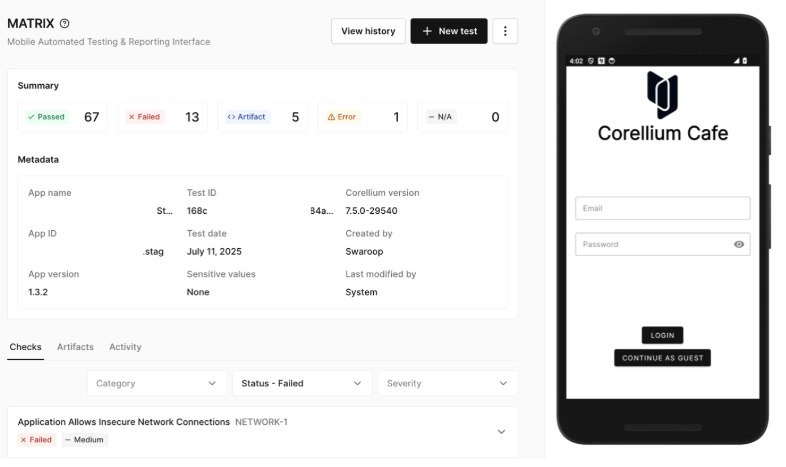
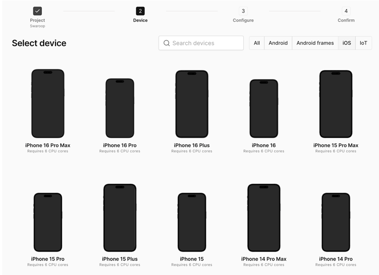
This is where Corellium Viper with MATRIX technology becomes a game-changer. Instead of waiting until after your app is live to discover security problems, MATRIX helps you find and fix them while you're still building.
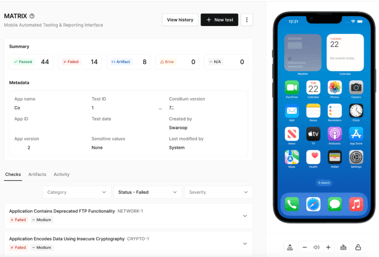
MATRIX runs hundreds of automated security tests in just minutes. It checks for all the common problems that lead to expensive breaches:
The tool gives you a detailed report showing exactly what's wrong and how to fix it. More importantly, it does this while fixing the problems is still cheap and easy.
Here's a rough cost comparison:
- Running MATRIX tests during development is highly cost-effective.
- Fixing a vulnerability in development: 2-4 hours of developer time
- Fixing the same vulnerability after a breach: Potentially millions in damages
The Bottom Line
Security debt is real, and it's expensive. Every day you delay proper security testing, that debt grows. Eventually, it comes due - and when it does, the bill is always bigger than you expected.
Companies like T-Mobile and Equifax learned this the hard way. T-Mobile spent over $380 million just on settlements, while Equifax's total bill exceeded $1.7 billion. Both of these disasters could have been prevented with regular security testing and prompt vulnerability patching.
The smart money isn't on hoping nothing goes wrong. The smart money is on tools like Viper with MATRIX that help you catch problems early, when fixing them costs hundreds of dollars instead of hundreds of millions.
Your CFO will thank you. Your customers will thank you. And you'll sleep better at night knowing your app isn't a ticking time bomb waiting to explode your budget.
Don't let security debt compound. The interest rate on this particular debt is way too high to ignore.
Ready to tackle your mobile security debt before it becomes a crisis? Get your free trial of Corellium Viper with MATRIX technology and start automated mobile security testing today. Because fixing problems in development is always cheaper than explaining them to lawyers.